Universal Design Principles
2026-03-30
List of 200 design principles presented in:
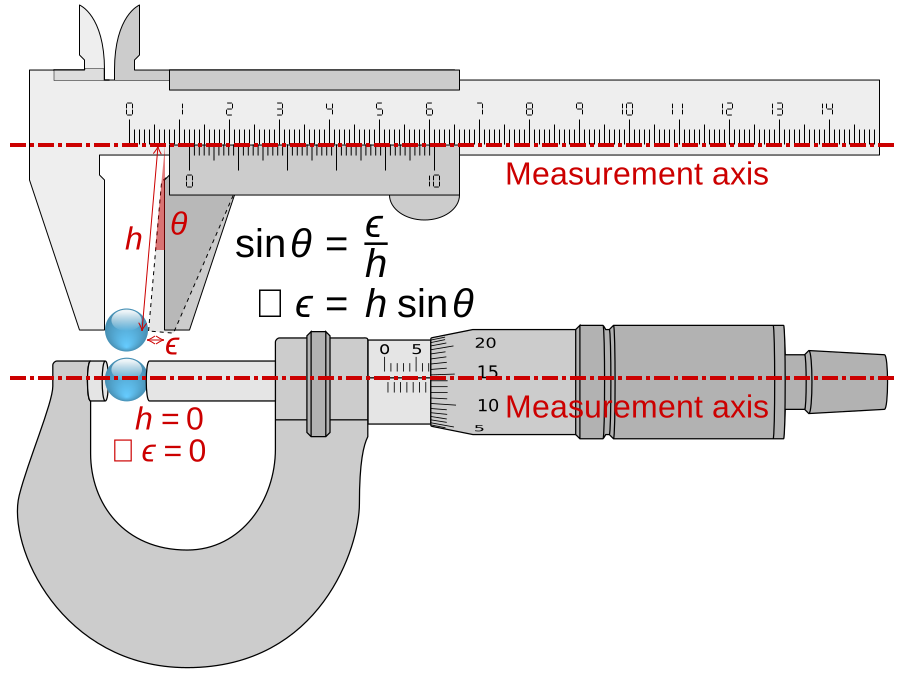
1. Abbe Principle
The Abbe error was formulated in the context of microscopes and is an important guideline for the design of measuring instruments. The error arises when the measuring scale is not aligned with the distance being measured.
Transferred into other fields, the principle suggests, to do your observations as close as possible to the thing under scrutiny. Every distance or intermediary adds noise and error to the observation.
2. Accessibility
There are four characteristics of accessible designs:
- Perceptibility — everyone can perceive the design, regardless of sensory abilities.
- Operability — everyone can use the design, regardless of physical abilities.
- Simplicity — everyone can easily learn and understand the design, regardless of experience, literacy, or concentration level.
- Forgiveness — designs minimize the occurrence and consequences of errors.
A button is considred accessible if it’s colors and shape convey it’s function. So people with impairment of vision can easily use it.
3. Ackoff’s Law
Ackoff’s law states that doing the wrong things even if perfectly executed will never be successful. While doing the right things sufficiently is more likely to succeed.
Efficiency follows strategy and agility.
Doing the right things is ‘wisdom’, and doing things right is ‘efficiency’.
4. Aesthetic-Usability Effect
Research suggest that people are more likely to accept, care for, keep, display, and repeatedly use aesthetic things. Additionally, these things are perceived to have greater value and prices than uglier things with the same functionality.
5. Affordance
If the form and features of a thing make it well suited for its intended use affordances are good. So is a button good for pushing and a lever good for pulling, but not the other way around.
Good affordances remove friction and prevent errors, while bad affordances often lead to false usage.
When affordances are correctly applied, it will seem inconceivable that a thing can function or be used otherwise.
6. Alignment
Aligned elements appear more stable, cohesive and united, while the eyes are guided along predictable lines connecting the dots.
Alignment is regularly runs along edges and axes in symmetry. Sometimes however you want to balance the perceived weight of related parts. This is often done best by eye, especially if the elements have irregular shapes.
Alignment does not have to be right, center, or left. There are grid systems, circular alignments and many more.
7. Anchoring
If there is a range of different signals, the first, and last one are often taken as the anchors, with the signals in between having less of an influence.
While most of the research focusses on numbers, the effect applies to all senses. Sounds, arguments, colors all change in light of the referenced anchor.
Anchors are hard to circumvent and play a part in decision-making and judgments.
8. Anthropomorphism
Humans recognize certain forms and patterns as humanlike — specifically those that resemble faces and body proportions. In design this can be used to attract attention and positive feedback, if done tastefully.
Robots that interact with humans are frequently given humanlike appearances (standing upright, friendly faces) and/or communication skills. Overly realistic humanlike looks and communication are however uncanny.
Abstract anthropomorphic forms, can elicit associations of sexuality and vitality (feminine forms), empathy (babylike, round) or elicit masculine, aggressive associations (angular shapes).
9. Aposematism
In nature bright color combinations, behaviors such as rattling or hissing, and patterning such as zigzags and stripes attract attention and signal danger to potential predators. Aposematic signals evolved to be seen and to be remembered.
The long-wavelength colors of red, orange, and yellow are more contrasting against natural green backgrounds than green, blue, and violet and more conspicuous under a range of lighting and weather conditions. They are also effectively detected and interpreted by people with color blindness and commonly used to attract attention and signal danger in safety signage.
Aposematic patterns that feature angular versus round features appear to be the most effective danger signals to humans, such as patterns with triangles, diamonds, stripes, and zigzags.

Photo by James Wainscoat on Unsplash